
A 66 – Open Scientific Communication
Just as «Open Access» once revolutionized scientific communication by providing free access to knowledge, A 66 aims to serve as a platform that brings people together and fosters open, creative communication — whether as a purely local event or online — globally connected in a hybrid format.


New format Round Table
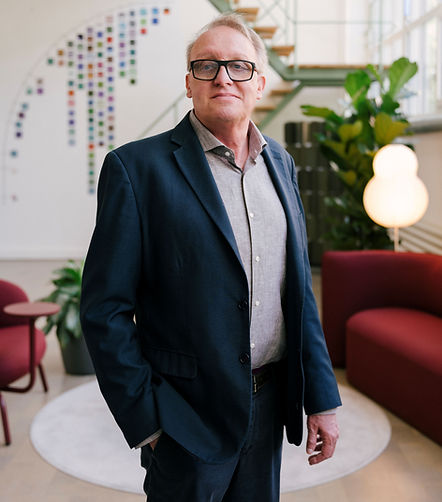
My name is Peter Roth, and I am the host of A 66 — a unique event location in the heart of Basel designed to foster open scientific communication.
At MDPI, it is a core mission to support independent scientific exchange among experts; A 66 was established with this purpose in mind. We organize round-table discussions, consensus meetings, and similar events, either with participants on-site or in hybrid formats connecting experts from around the globe.
As a Senior Executive Advisor and former Head of Publishing at MDPI, with more than 35 years of experience in leadership roles within academic publishing, I am delighted to support this forward-looking and impactful initiative on behalf of MDPI.
Dear visitor, you are warmly invited to access the outcomes of these expert discussions and to share them with interested colleagues.
Please feel free to contact me directly via e-mail, roth@mdpi.com, if you have topic ideas worth discussing, would like to participate, or are interested in collaboration.
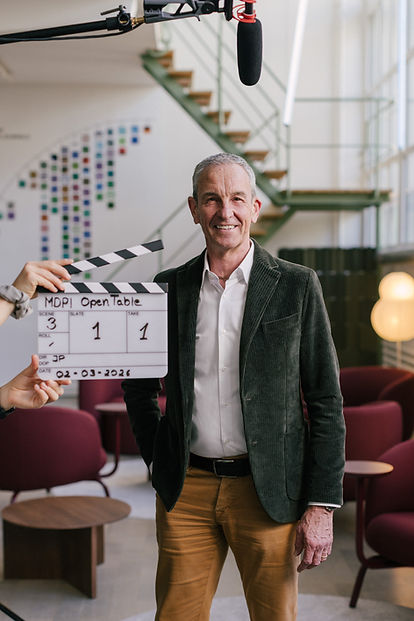
We hope you enjoy reviewing the Round Table format. You can find further information about the participants and additional articles on the topic below on this page.
Peter Roth, Open Scientific Communication Host and Managing Director, A 66
Truth and Pitfalls in Evidence-Based Medicine
On behalf of MDPI, it is my great pleasure to welcome you to this Round Table discussion at the A 66 Event Location here in Basel, Switzerland, a place for Open Scientific Communication.
Today’s discussion, entitled «Truth and Pitfalls in Evidence-Based Medicine,» brings together an outstanding panel of internationally renowned experts in the field of nephrology.
We are truly honored by their presence and look forward to an engaging and thought-provoking exchange.
Enjoy reviewing the discussion

Our Participants in Detail

Prof. Francesco Locatelli
MD, FRCPB Nephrology Lecco, Lombardia, Italy
Prof. Francesco Locatelli is a world-famous Italian nephrologist from Lecco, renowned for his work as an expert in many fields of nephrology including anemia, glomerulonephrithis, CKD progression, and dialysis.
He served as Director of the Department of Nephrology and Dialysis at Hospital «A. Manzoni» in Lecco, President of the European Renal Association– (ERA), International Society of Blood Purification, and Italian Society of Nephrology. He held leading roles in international guideline development and research initiatives.
He is also known as a member of KDIGO guideline work groups and an Editorial Board member of leading nephrology journals.
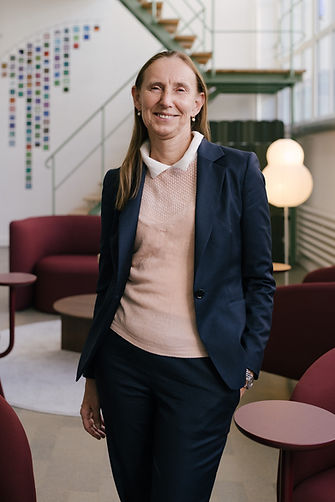
Prof. Jolanta Małyszko
Prof. Dr. Hab. N. Med. Nephrology, Dialysis and Internal Medicine,
Warsaw Medical University, Poland
Prof. Jolanta Małyszko is a board certified specialist in internal medicine, nephrology, clinical transplantation and hypertension. In 1995, she received a Ph.D. from Hamamatsu University School of Medicine, Japan. Now she is the head of the Department of Nephrology, Dialysis and Internal Medicine, Warsaw Medical University, Poland.
She was a member of the ERA Executive Council, as well as a member of the Executive Council of KDIGO and ISPD. She is a current member of the Executive Council of ISN. She was a Board Member of the ERAKI working group dealing with acute kidney injury, in addition to the Strong Kidney Task Force of ERA. Now she is the Chair of the ONCOERA working group of ERA.
Her major research interests are as follows: renal replacement therapy, onconephrology and biomarkers of AKI, kidney function after solid organ transplantation and stem cell transplantation, cardiovascular complications, iron metabolism, and anemia in CKD.

Prof. Michel Jadoul
M.D. Professor Emeritus at Catholic University of Louvain, Belgium
Prof. Michel Jadoul has been chairing the Division of Nephrology of the Cliniques Univ. St Luc, Brussels, until 2023, and is now a young emeritus Professor at the same clinic.
His clinical activities still include the follow-up of CKD and hemodialysis patients. He has been a member of the ERA Council and he has been co-chair (2019-2025) of (KDIGO) and is now treasurer of KDIGO.
He is since June 2025 Co-President of the European Kidney Health Alliance, lobbying for kidney health at the EU level.
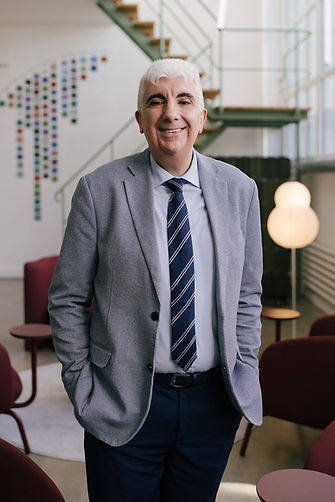
Prof. Giovanni Tripepi
Biostatistician, MSc, PhD, Head of Department at Italian National Research Council, Reggio Calabria, Italy
Prof. Giovanni Tripepi is a Clinical Epidemiologist with a background of biostatistician known for his research on cardiovascular risk and outcomes in chronic kidney disease. He serves as Research Director at the National Research Council of Italy and has held leadership roles in epidemiology and biostatistics units. He has contributed to international guideline committees, editorial boards of nephrology journals, and major collaborative research networks in renal medicine.
Related Articles
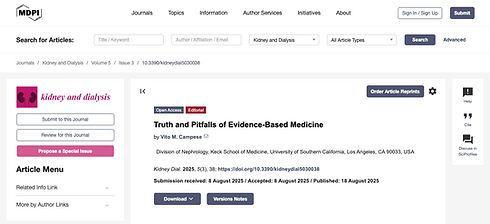
MDPI Kidney and Dialysis, August 2025
Truth and Pitfalls of Evidence-Based Medicine
The practice of medicine needs to be evidence-based. But what constitutes evidence? Evidence is anything that can be used to prove something. But the evidence can be wrong, subject to various interpretations, or (rarely) fabricated…
by Vito M. Campese

MDPI Kidney and Dialysis, December 2025
Caution in Interpreting Number Needed to Treat and Number Needed to Harm in Clinical Trials
We read with great interest the recent paper by Campese (2025) [1] and we would like to highlight an important caution regarding the use of the Number Needed to Treat (NNT) and Number Needed to Harm (NNH) in clinical decision-making. While these metrics translate relative risk reductions or increases into absolute measures, they can be misleading when compared across studies with populations of different baseline risk…
by Giovanni Tripepi and Graziella D’Arrigo
Further readings →

New England Journal of Medicine, March 2026
Number Needed to Treat
Medical evidence comes in the form of population statistics, but patients behave like people, each one unique. Physicians walk the line, studying bell curves but hoping each intervention has an NNT of 1. …
by W. Michael Brode, M.D.

MDPI Kidney and Dialysis, April 2026
Beyond Relative Risk: A Methodological Framework for Interpreting Measures of Effect and Improving Data Presentation in Randomized Controlled Trials (RCTs)
Randomized controlled trials (RCTs) are the gold standard for evaluating the efficacy and safety of medical interventions. However, the interpretation of their results is often obscured by an overreliance on relative measures of effect, such as relative risk reduction (RRR) and hazard ratios (HRs). While statistically robust, these measures may mislead clinicians and patients when used in isolation. This article provides a methodological framework for the comprehensive interpretation of treatment effects in RCTs, emphasizing the importance of integrating absolute measures such as absolute risk reduction (ARR), number needed to treat (NNT), annualized NNT (aNNT), and number needed to harm (NNH) …
by Giovanni Tripepi, Jolanta Małyszko, Michel Jadoul and Francesco Locatelli
Further readings →
Dermatopathology specialists examine skin tissue under the microscope to identify diseases that often cannot be diagnosed accurately by looking at the skin alone. The play a key role by detecting skin cancer early and helping doctors to chose the right treatment. As skin cancer rates rise and medicine becomes more precise and personalized these specialists are becoming increasingly important and in demand.
Dermatopathology 2030:
Navigating the Digital and Molecular Frontiers
Today we are honored to welcome three internationally recognized top rank scholars to discuss the current challenges in the field of Dermatopathology.
Enjoy reviewing the discussion

Our Participants in Detail

Prof. Gürkan Kaya
M.D., PhD, Dermatology, Dermatopathology, Geneva, Switzerland
Prof. Gürkan Kaya is Professor of Dermatology
and Head of Dermatopathology unit at the university hospital of Geneva specializing in molecular skin research.
He also serves as President of the European Society of Dermatopathology and Editor in Chief of the Journal Dermatopathology published open-access by MDPI.

Prof. Maria Teresa Fernández Figueras
Pathology, Barcelona, Spain
Prof. Maria Teresa Fernández Figueras is Professor of Pathology and an internationally recognized expert currently leading the department of anatomic pathology at the hospital Universidad Rigeneral de Catalunya in Barcelona.
She is widely known for her work in inflammentory skin diseases, melanoma research and the digital dermatopathology education.
Prof. Carlo Francesco Tomasini
Dermatology, Pavia, Italy
Prof. Carlo Francesco Tomasini is an Associate Professor of Dermatology at the University of Pavia and Director of Dermatology at the IRCCS Policlinico San Matteo.
As an internationally recognized expert he is co-founder and currently Secretary General of the European Society of Dermatopathology.
He is widely known for his contributions to inflammatory and neoplastic skin diseases, particularly cutaneous lymphomas and adnexal tumors.


